
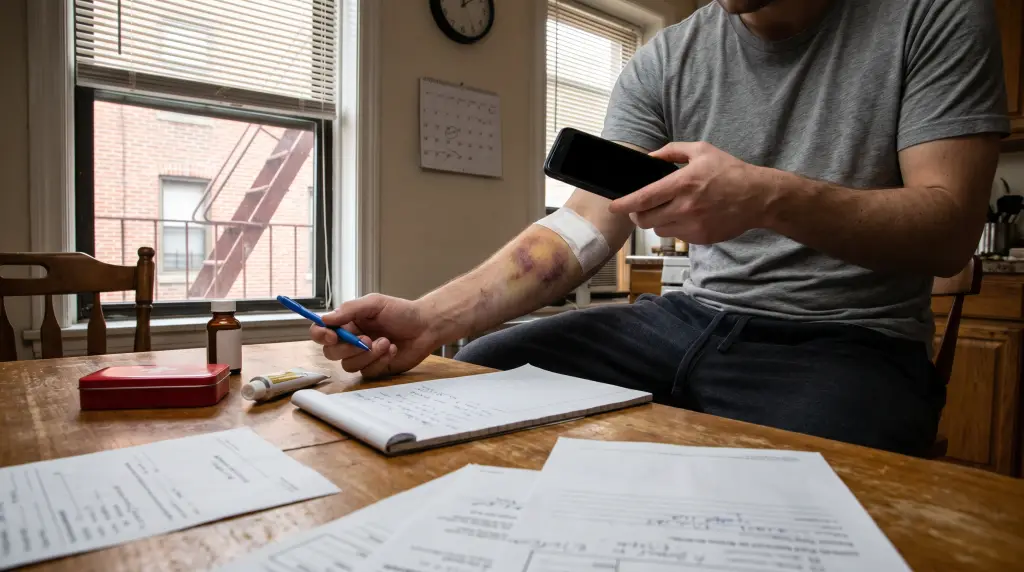
Injury claims often fail or stall before an attorney sees the file because people overlook important steps, and those missteps can cost thousands. Missing medical records, incomplete NYPD crash documentation or uncertainty about the responsible property owner can leave a lawyer without the evidence needed to evaluate a New York injury claim.
After an injury in New York, your rights depend on where and how it happened: a car crash triggers no-fault benefits under Insurance Law Article 51, subject to eligibility rules relevant to automobile accident claims and no-fault benefits; a workplace injury runs through the Workers' Compensation Board; and a fall on property raises premises liability questions. An NF-2 application, Workers' Compensation Board Form C-3 or property maintenance records may be relevant to these different paths.
In this guide, we’ll unpack the most common blind spots, show you ways to protect your rights, and explain why a personal injury attorney can make a difference in Queens, Brooklyn, Manhattan and the rest of New York City. That includes understanding how medical evidence and accident records may support a lawsuit in Queens County, Kings County or New York County Supreme Court.
Most claims fail because of timing, paperwork gaps and social media slips. Knowing the hidden rules can help preserve value before a personal injury attorney steps in. New York’s CPLR §214 generally governs the limitations period for negligence injury lawsuits, while incomplete MRI reports or inconsistent Instagram posts can complicate the evidence supporting a claim.
If you’ve been hurt in a slip-and-fall, car crash or construction accident, the clock is already ticking when you seek care. Legal deadlines may run from the accident rather than the first medical visit. Acting fast and documenting everything, including emergency department records, orthopedist findings and relevant NYC Department of Buildings records, can help keep your claim alive.
We’ll walk through seven critical moments, from the first 72 hours to the role of online posts, so you can avoid costly mistakes and understand what a personal injury attorney really brings to the table. That includes connecting physical therapy records to reported symptoms, evaluating insurance paperwork and addressing how Facebook or Instagram content may surface during a deposition.
Why Most Personal Injury Claims Fail Before They Ever Reach an Attorney
Early missteps like missing deadlines or poor evidence often sink a claim before a lawyer can intervene, especially in busy New York boroughs.
In Queens, Brooklyn and Manhattan, the majority of injury claims never make it past the intake stage because they do not meet basic procedural thresholds. New York City courts, including Queens, Kings and New York County Supreme Courts, enforce strict filing deadlines, and proving liability requires solid evidence. For instance, General Municipal Law §50-e generally requires a Notice of Claim within 90 days for covered municipal tort claims, including claims involving the NYC Department of Sanitation. Claims involving the MTA require checking the particular authority or subsidiary involved and the governing statute, rather than assuming every transit claim follows the same municipal procedure.
When a claimant skips initial steps, such as notifying the responsible party where required or preserving medical records, the case loses momentum, and attorneys may be forced to decline because of low recovery odds. Emergency department records, MRI reports and an orthopedist’s treatment notes can help connect the accident to documented injuries.
Common Early Pitfalls
- Missing Deadline: Failing to file a Notice of Claim within 90 days for covered government claims can significantly hinder recovery. General Municipal Law §50-e governs this requirement for many municipal tort claims, although exceptions and entity-specific rules require review.
- Insufficient Evidence: Without photographs, witness statements or medical records, insurers can argue the injury never occurred. NYPD accident reports, dated scene photographs and ICD diagnosis records can help document the incident and resulting harm.
- Premature Settlement Talks: Accepting a low offer before consulting a personal injury attorney often leaves money on the table, a trap many New York residents fall into. An orthopedist’s prognosis and anticipated physical therapy needs may reveal losses not reflected in the initial offer.
Understanding these early hurdles can help preserve the strength of a case before a personal injury attorney even enters the picture. A rushed settlement may later prove inadequate once the full scope of damages is revealed. Reviewing medical documentation, wage-loss records and any proposed settlement release can clarify what losses are being resolved and whether future treatment needs remain uncertain.
The 72‑Hour Window That May Influence Your Case’s Settlement Value
The first three days after an injury are critical for gathering evidence and medical care, directly influencing the settlement amount a personal injury attorney can negotiate.
Within the first 72 hours, insurers begin their own investigation and may start making lowball offers. Prompt scene documentation, medical attention and witness contacts can dramatically strengthen a claim’s potential value, although results depend on the evidence. Reporting a qualifying motor vehicle accident to the NYS DMV within 10 days using Form MV-104 is also crucial for compliance with New York Vehicle and Traffic Law. That driver-reporting requirement generally applies when an accident involves injury, death or property damage exceeding the statutory threshold; an NYPD report does not replace the required driver filing.
On Manhattan’s bustling streets, including Bowery, or the quieter avenues of Long Island, the same practical rule applies: earlier action generally preserves stronger evidence and gives a personal injury attorney more negotiating leverage. Photographs of roadway conditions and available NYPD accident records can help establish what happened before conditions change or memories fade.
A quick snapshot of why each action matters:
Immediate Actions
- Scene Documentation: Photos of the accident spot, injuries and hazardous conditions preserve visual proof, often the strongest bargaining chip. On a Manhattan sidewalk, images showing the street address, pavement defect and surrounding area can help identify the location and relevant conditions.
- Medical Care: Even when someone feels fine, a professional evaluation creates a medical record that can help link an injury to the incident. Emergency department notes, ICD diagnosis records and any clinically indicated MRI can document symptoms and findings.
- Witness Information: Names, phone numbers and statements from bystanders can corroborate an account of events. Recording where each witness stood and what they observed can help an attorney compare their account with an NYPD accident report.
Treating the first three days as a high-stakes evidence-gathering window gives a personal injury attorney concrete facts for negotiating a fair settlement. Insurers often settle early, but a well-documented claim can support an offer in a higher range. Records from an orthopedist and physical therapy providers can also clarify ongoing treatment needs that an early offer may overlook; the timing alone does not determine compensation.
What Insurance Adjusters Actually Mean When They Call Your Injury ‘Pre‑Existing’
Adjusters label injuries as ‘pre‑existing’ to reduce liability, but you can counter with proper medical documentation and timelines.
When an adjuster says your injury was pre‑existing, they’re trying to shift blame onto a prior condition. In New York, it is generally understood that a clear causal link is needed between the accident and new symptoms, which many claimants overlook. New York law, as reflected in jury instructions like PJI 2:12, often considers whether an accident 'aggravated' a pre-existing condition, allowing for recovery even if an injury existed prior to the incident.
Understanding these medical nuances helps refute the adjuster’s argument and preserve the value of a claim, especially when a new incident aggravates chronic problems. An orthopedist’s assessment, physical therapy notes and ICD diagnosis records can help explain changes in symptoms and function, rather than merely identify a longstanding diagnosis.
Counter‑Strategies
- Medical Timeline: A detailed chronology can show when symptoms began relative to the accident, connecting emergency department visits, orthopedist appointments and physical therapy records to the reported changes.
- Expert Opinion: A specialist’s assessment can distinguish new trauma from old conditions, a standard practice in personal injury litigation. An orthopedist can explain whether examination findings and MRI results support new injury or aggravation.
- Prior Records Review: Reviewing all previous medical records may help demonstrate that the current injury is distinct, a step often missed by claimants. Earlier MRI reports and primary care notes can also document a previously stable condition that worsened.
- Pain Level Documentation: A daily pain diary noting intensity and triggers can help create a clear before-and-after picture. Entries about walking, sleep and physical therapy can supplement, rather than replace, clinical documentation.
- Legal Reference: Understanding the burden of proof for causation in personal injury claims can be helpful. In New York Supreme Court litigation, medical evidence generally needs to connect the claimed injury or aggravation to the accident.
When a solid medical narrative connects the accident to new injury or aggravation, the adjuster’s pre-existing-condition argument loses weight, and a personal injury attorney can use that evidence to negotiate a stronger settlement. The practical pattern described here is a shift from denial toward a reasonable offer once the medical facts become difficult to dispute, although that is not an assured outcome or an established frequency. Consistent orthopedist reports, MRI comparisons and physical therapy records can strengthen that negotiation while leaving other liability and damages questions open.
When Hiring a Personal Injury Lawyer Too Early Costs You Money
Engaging counsel before gathering evidence can lead to higher fees and missed opportunities; timing matters for cost‑effective representation.
Many New Yorkers think the moment they visit an emergency room they should call a personal injury attorney. While early advice is valuable, premature engagement can inflate costs if the case lacks solid evidence. It can be beneficial to understand that attorney's fees in personal injury actions are often governed by Judiciary Law §474-a, which caps fees in medical malpractice cases, though general personal injury cases are typically subject to a retainer agreement between client and attorney.
A lawyer’s time is billed based on the work required, and without a clear factual foundation, the attorney may need to spend extra resources on discovery that could have been avoided.
Cost‑Saving Steps
- Evidence Gathering: Collecting photos, witness contacts and medical records, including emergency room reports, before the lawyer’s initial meeting when practicable can be helpful. This can reduce billable hours under an hourly arrangement and avoid duplicative investigation without making complete records a prerequisite to consultation.
- Initial Consultation Only: The first meeting can provide a strategic overview before a decision on full representation. It can help to ask about CPLR §214 and any claim-specific timing rules so that gathering evidence does not inadvertently delay necessary action.
- Claim Strength Assessment: An attorney can evaluate the likelihood of success based on the facts already available, including NYPD reports, witness accounts and medical findings, and explain how New York’s comparative-fault rule under CPLR §1411 may affect recovery.
- Fee Structure Discussion: It can help to discuss whether a contingency fee is appropriate given the case’s complexity and potential recovery. Topics may include how the retainer treats litigation expenses and whether special fee rules, such as Judiciary Law §474-a for medical malpractice, apply.
- Duplicate Services: Reviewing whether the attorney’s planned work overlaps with steps already completed, such as independent medical evaluations, may help identify duplication. Sharing existing MRI reports and orthopedist records may prevent duplication, although an independent medical examination requested during litigation may serve a different purpose.
A solid evidentiary base may help limit unnecessary expenses and give a personal injury attorney a clear roadmap, without making delayed formal representation a prerequisite. A smoother, faster settlement may be possible when the lawyer can focus on negotiation rather than fact‑finding, but neither is assured.
The Medical Documentation Gap That Undermines Even Strong Injury Claims
Missing or incomplete medical records undermine even strong injury claims by creating a documentation gap that insurers exploit, but targeted strategies can close it before a personal injury attorney files a claim. Hospital charts, MRI reports and physical therapy notes help connect the accident, diagnosis and treatment.
A common reason claims falter in Queens, Brooklyn and the wider New York City area is the lack of a complete medical record. Insurers scrutinize every file, and any gap can be used to dispute the severity of your injuries, including missing orthopedist assessments or physical therapy progress notes. Addressing the gap could involve submitting specific forms, such as Form C-3, the employee claim form submitted to the New York State Workers' Compensation Board for a workers' compensation claim. That form officially records relevant injury and treatment details, but it does not replace the treating providers' full medical records.
Closing that gap requires proactive steps, from requesting full records to coordinating with specialists, ensuring that a personal injury attorney has a robust file to present. Matching MRI findings, ICD diagnosis records and specialist assessments with documented symptoms helps make that file coherent.
Key differences between complete and incomplete records:
Documentation Checklist
- Full Record Request: A full record request can cover every report, imaging study and prescription from all treating physicians, including MRI images, radiology interpretations and physical therapy records.
- Chronological Summary: A timeline linking each medical visit to the accident can clarify the claimed causation through dated hospital, orthopedist and physical therapy entries.
- Specialist Referrals: If initial doctors cannot explain the injury, a specialist's opinion, such as an orthopedist's assessment, can add depth and diagnostic detail to the record.
- Pain Management Logs: A record of all medications, dosages and side effects, paired with prescription records and physical therapy notes, can help demonstrate ongoing impact.
- Insurance Coordination: Appropriate authorizations can allow a health insurer to release relevant information to a personal injury attorney, while clinical records may be requested separately from treating providers.
When the documentation gap is eliminated, a personal injury attorney can focus on strategy rather than chasing records, which can support faster resolutions and higher recoveries without assuring either outcome. A complete medical file may affect settlement offers, but a dramatic shift is not assured. Complete MRI reports, orthopedist opinions and physical therapy records can strengthen that presentation, although an insurer may still contest causation, severity or the value of the claim.
How Contingency Fee Structures Change Which Cases Attorneys Will Actually Take
Contingency fees align attorney incentives with client outcomes, but they also filter out low‑value cases, affecting which personal injury claims get representation.
A contingency fee generally means the attorney receives a legal fee only if the client wins compensation through a settlement or judgment, typically as a percentage of the recovery, a topic in common questions about contingency fee arrangements. This model encourages lawyers to take cases with strong merit, especially in competitive New York markets such as Manhattan. Litigation expenses are a separate issue addressed in the written retainer agreement.
However, the percentage may vary with case complexity, risk and potential recovery, subject to applicable New York fee limits, influencing whether a personal injury attorney accepts a claim. New York generally requires contingency fee agreements to be in writing and clearly state their terms, including the recovery percentage and treatment of expenses. Where the fee is calculated on net recovery, the retainer agreement explains the deductions. Medical malpractice fees follow the specific statutory schedule in Judiciary Law §474-a rather than unrestricted negotiation.
Fee Factors
- Recovery Size: Larger settlements may support an attorney’s request for a higher percentage where permitted, while smaller claims may involve reduced rates intended to make representation workable and attractive to attorneys. These are not automatic pricing rules, and applicable New York court rules and, for medical malpractice, Judiciary Law §474-a constrain fee arrangements.
- Case Complexity: Multifactorial injuries or multiple defendants increase risk, potentially prompting attorneys to adjust their contingency split within applicable limits. Reviewing MRI findings, taking depositions and assessing allocation of liability under CPLR Article 16 can affect the anticipated work and expense of a New York personal injury case.
- Client Cooperation: Prompt provision of evidence and willingness to follow legal advice can support discussion of a lower fee percentage, although no reduction is automatic. Organized ICD diagnosis records, physical therapy records and deposition preparation can help counsel evaluate the work involved; any agreed fee terms belong in the written retainer agreement.
Understanding how contingency structures work helps set realistic expectations and identify an attorney whose fee aligns with a case’s potential. In practice, the pattern most often encountered is a transparent fee agreement reflecting both risk and reward. When discussing a claim with Garber Legal PLLC at 263 Bowery in Manhattan, it can help to ask how the retainer addresses litigation expenses, deductions and the attorney’s percentage.
Why Your Social Media Posts Matter More Than Your Medical Records in Court
Social media posts can undermine medical evidence when they contradict injury claims, although they do not automatically carry more weight than medical records in court. Insurers monitor online activity, and careful management of Facebook and Instagram posts can protect your case’s credibility.
In today’s digital age, insurers routinely scan Facebook, Instagram and Twitter, now called X, for posts that could undermine a personal injury claim. A photo of you hiking weeks after a slip-and-fall can be used to argue you’re not seriously injured, even when the image does not show pain or physical limitations. If that information contradicts testimony, defense counsel can use it during discovery and, subject to evidentiary rules, at trial in New York’s Supreme Courts, including New York County Supreme Court. Questions at a deposition may compare the post with reported symptoms and treatment records.
Even casual comments about feeling fine can be twisted into a denial of pain, making social media a hidden battlefield for your case. Defense counsel may compare an Instagram caption with an orthopedist’s notes or physical therapy records to challenge the consistency of reported symptoms.
Social Media Best Practices
- Privacy Settings: Switching Facebook or Instagram profiles to private and limiting who can view posts during the claim period can reduce public exposure, but relevant private content may still be subject to discovery.
- Injury References: Posts about activities suggesting full recovery may be used to challenge an injury claim.
- Document Disputes: If a friend asks about your condition, a brief, accurate statement and a preserved record for your attorney can provide context if a Facebook exchange later becomes disputed evidence.
- Guidance From a Lawyer: It can help to discuss specific questions about posting or deleting content with a personal injury attorney. Relevant Facebook posts and Instagram messages may require preservation, so deletion can create evidence problems.
- Tagged Content: Tagged photos or mentions may reveal activity that appears to contradict an injury claim.
Treating an online presence as part of an evidence strategy may help address insurers’ use of contradictory posts. A digital footprint that aligns with the medical narrative may support a smoother litigation process, but does not assure one.
Partial fault does not automatically end a claim in New York, because CPLR §1411 reduces damages by the injured person’s share of fault, and CPLR Article 16 can limit what some defendants pay for non-economic losses. Article 16 generally concerns defendants found 50 percent or less responsible, subject to statutory exceptions. These allocation rules are distinct from whether social media evidence undermines testimony about an injury.
Protecting Your Claim Effectively
Navigating a personal injury claim in Queens, Brooklyn, Manhattan and the broader New York area requires timing, solid documentation and savvy handling of both medical and digital evidence. Avoiding early pitfalls, acting within the critical 72‑hour window, and understanding how insurers think may help support a claim. Understanding the principles of comparative negligence under CPLR §1411 is vital for claims in New York, as it allows recovery even if the injured party was partially at fault, simply reducing the awarded damages proportionally.
If you’re ready to safeguard your rights, consider a consultation with a personal injury attorney experienced in these matters who can tailor strategy to your unique situation. Reach out today to help protect your future and pursue compensation.
This article is general information, not legal advice, and does not create an attorney-client relationship. Attorney advertising.