
Proper injury documentation can make or break your personal injury claim. Missing critical evidence early often costs thousands in settlement value.
Most people think documenting injuries means taking a few photos and keeping medical bills, but that approach leaves massive gaps that insurance companies exploit to minimize payouts. The reality is that personal injury claims hinge on a precise chain of evidence that starts the moment an injury occurs and continues throughout treatment. In New York’s complex legal landscape, from Queens to SoHo, missing even one piece of documentation can derail an otherwise strong case.
This guide walks you through the systematic approach attorneys use to build injury documentation that may withstand insurance scrutiny and support claim value. You’ll learn about specific evidence commonly collected, the deadlines that matter in NYC, and the common mistakes that weaken claims. These steps may help create a comprehensive record that supports your injury claim, from initial medical expenses to long-term impacts on your life.
Step 1: Immediate Medical Attention and the Initial Record
The first 24 to 48 hours after an injury are critical for both your health and your legal claim, yet many people delay seeking medical care or choose inadequate treatment options. Emergency room visits, urgent care evaluations, or immediate physician consultations create the foundational medical record that establishes when your injury occurred and its initial severity. This timing matters enormously because insurance companies scrutinize gaps between accidents and medical treatment, often arguing that delays indicate minor injuries or alternative causes.
Failing to seek prompt medical attention gives insurers ammunition to claim your injuries aren’t serious or weren’t caused by the incident in question. Even if you feel ‘fine’ initially, adrenaline and shock can mask significant injuries that worsen over hours or days. The medical record from your first treatment becomes the baseline against which all future care is measured, making it essential to describe all symptoms accurately and completely, even seemingly minor ones that might develop into larger problems. For instance, a prompt visit to an emergency room or a primary care physician can establish the initial diagnosis needed to meet the serious injury threshold under New York Insurance Law §5102(d).
Here’s a comparison of initial medical care options and their impact on your claim documentation:
Step 2: Photographs and Documentation of the Accident Scene and Your Injuries
Visual evidence often tells the story that medical records alone cannot convey, yet most people either skip photography entirely or take poor-quality images that lack the detail needed for legal proceedings. Professional-grade documentation requires capturing multiple angles of the accident scene, your visible injuries, and any property damage or hazardous conditions that contributed to the incident. The key is to photograph everything while preserving the original EXIF metadata that proves when and where images were taken, as this data becomes crucial for authenticating evidence in court.
Insurance adjusters and defense attorneys routinely challenge the authenticity and timing of photographs, making proper documentation techniques essential for maintaining credibility. Using a smartphone camera’s highest available resolution (at least 12 megapixels) and avoiding filters or editing apps may help preserve the images’ legal value. Wide shots can show context, medium shots can show relationships between elements, and close-ups can capture specific details like injuries, damage, or hazardous conditions. It can be beneficial to preserve original photos in a secure location, such as cloud storage, especially if they capture conditions relevant to a New York City Department of Buildings violation or an MTA property defect.
Photography Essentials
- Scene Overview: Wide-angle shots can show the entire accident location, including surrounding areas, traffic patterns, weather conditions, and any visible hazards or contributing factors that played a role in an injury.
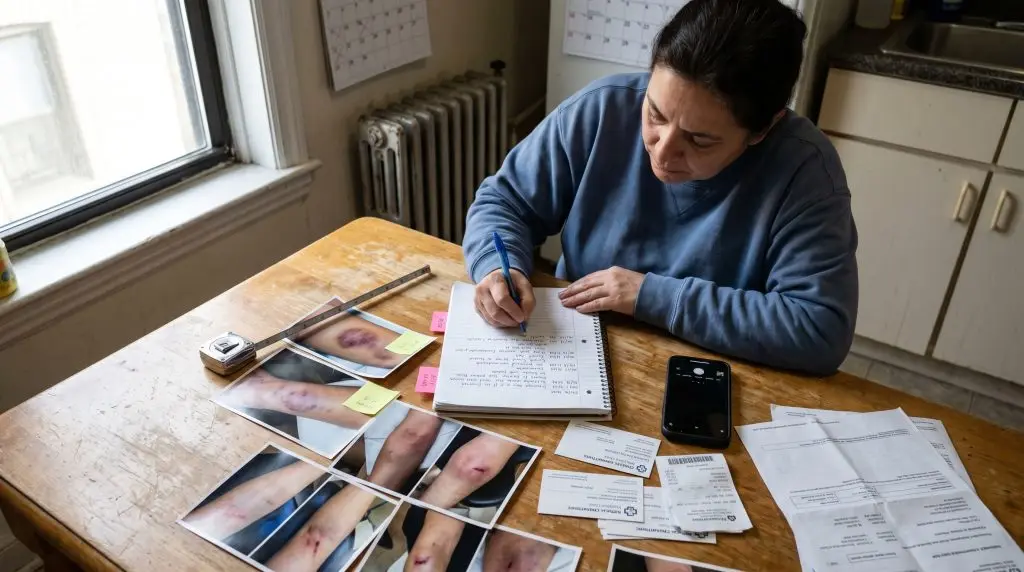
- Injury Close-ups: Photographs of all visible injuries taken immediately and daily during healing can use consistent lighting and angles to show progression, with a reference object in each image for scale when possible.
- Property Damage: Documentation can show damage to vehicles, personal belongings, clothing, or other property, using multiple angles and including serial numbers or identifying features that prove ownership and pre-accident condition.
- Hazardous Conditions: Photographs can capture dangerous conditions like wet floors, broken pavement, inadequate lighting, missing safety equipment, or code violations that contributed to an accident occurring.
- Metadata Preservation: Exporting photos in original resolution with intact EXIF data can preserve evidence, while social media uploads or messaging apps may strip location and timestamp information needed for legal authentication.
Quality photographic evidence creates a visual narrative that helps insurance adjusters, attorneys, and potentially juries understand exactly what happened and how severely you were injured. These images become particularly valuable weeks or months later when the accident scene has changed and your injuries have healed. With comprehensive visual documentation secured, you can now focus on systematically collecting the medical records that will form the backbone of your claim.
Step 3: Complete Medical Records and Treatment Documentation
Medical records serve as the primary evidence linking your injuries to the accident, yet many people underestimate the complexity of obtaining complete documentation from multiple providers and facilities. The process requires more than just collecting bills and discharge summaries; comprehensive records include physician notes, diagnostic imaging, laboratory results, physical therapy reports, and detailed treatment plans that show the full scope of your injuries. In New York, healthcare providers must retain records for at least six years for adults, but getting copies requires proper HIPAA authorization and often involves fees that can add up quickly across multiple providers.
Insurance companies employ medical review teams specifically trained to find gaps, inconsistencies, or missing documentation that they can use to dispute claims, making thoroughness essential for protecting your interests. Many people focus only on emergency room records while overlooking follow-up care, specialist consultations, or ongoing treatment that actually demonstrates the long-term impact of their injuries. Understanding personal injury documentation helps you anticipate what insurers will scrutinize most heavily. To obtain complete medical records, one typically submits a written request and a HIPAA authorization form to healthcare providers, which is essential for presenting evidence in a New York Supreme Court case.
Record Types
- Emergency Records: Complete emergency department records include triage notes, physician assessments, nursing documentation, diagnostic test results, and discharge instructions that establish the immediate medical response to injuries.
- Diagnostic Imaging: Documentation can include all X-rays, MRIs, CT scans, and ultrasounds with both the radiologist’s written reports and the actual digital images, as visual evidence of fractures, soft tissue damage, or internal injuries may significantly strengthen a case.
- Treatment Notes: Detailed progress notes from all treating physicians, specialists, physical therapists, and other healthcare providers can show response to treatment, ongoing symptoms, and functional limitations throughout the recovery process.
Complete medical documentation creates an unbroken chain of evidence showing how your injuries have affected your life from the moment of impact through your ongoing recovery. This comprehensive record becomes the foundation for calculating both your immediate medical expenses and future treatment needs. With your medical evidence secured, you can now turn your attention to documenting the broader impact these injuries have had on your daily life and ability to work.
Step 4: Daily Impact and Financial Loss Documentation
The true value of a personal injury claim extends far beyond medical bills to include lost wages, diminished earning capacity, and the daily struggles that injuries create in your personal life, yet most people fail to document these ‘soft’ damages that often represent the largest portion of a settlement. Pain and suffering, loss of enjoyment of life, and functional limitations are real damages with real value, but they require consistent documentation to prove their impact to insurance companies and courts. A daily injury journal becomes one of your most powerful tools for capturing how your injuries affect sleep, work performance, family relationships, and recreational activities.
Insurance adjusters are trained to minimize non-economic damages by arguing that claimants have exaggerated their symptoms or returned to normal activities sooner than claimed. Detailed records of your daily limitations, pain levels, and missed opportunities create a compelling narrative that’s difficult to dispute when documented contemporaneously rather than reconstructed months later during settlement negotiations. Government resources on injury claims emphasize the importance of thorough documentation for all types of damages. For instance, if your injury affects your ability to work, documenting lost wages will be essential for making a claim for economic damages in a New York personal injury lawsuit, including determining lost wages for personal injury compensation.
Impact Documentation
- Pain Journal: Daily entries can record pain levels on a 1-10 scale, specific symptoms, activities that worsen or improve a condition, and how pain affects sleep, mood, and the ability to perform routine tasks.
- Work Impact: Documentation can include missed days, reduced hours, accommodations needed, tasks a person can no longer perform, and any changes in job responsibilities or career prospects resulting from injuries and ongoing limitations.
- Activity Restrictions: Records can describe recreational activities, household tasks, and social events a person has had to miss or modify due to injuries, including specific examples of how their lifestyle has changed since the accident.
- Financial Tracking: Records can include all injury-related expenses including medical copays, transportation to appointments, prescription medications, medical equipment, and any services a person now needs help with like housecleaning or yard work.
Systematic documentation of your injuries’ daily impact can create a narrative that supports a claim for damages such as ‘pain and suffering.’ This detailed record may help your attorney quantify the full scope of your losses and seek a settlement that reflects how the accident has changed your life. With comprehensive impact documentation in place, evidence preservation and organization for legal proceedings are additional considerations.
Step 5: Evidence Preservation and Documentation Organization for Legal Review
The final step in documenting your injury claim involves creating a systematic organization of all evidence while ensuring its preservation for the duration of legal proceedings, which can extend several years in complex cases. Digital evidence requires particular attention because photos can become corrupted, cloud storage can fail, and social media posts can be deleted, potentially destroying critical proof of your injuries and their impact. Professional attorneys recommend creating multiple backup copies of all digital files, maintaining original formats with intact metadata, and organizing documents chronologically to tell a clear story of your injury progression and recovery.
Proper evidence preservation also means understanding New York’s specific legal deadlines and requirements, as personal injury law varies significantly by jurisdiction and case type. New York generally has a three-year statute of limitations for most personal injury claims, but certain procedural requirements like Notice of Claim filings against municipal entities must be completed within 90 days. Having an organized documentation package ready for attorney review well before applicable deadlines can allow time for additional investigation or evidence gathering if needed. For claims against a city or state entity, such as the NYCHA or the MTA, a Notice of Claim must generally be filed within 90 days as per General Municipal Law §50-e.
Here’s a timeline of critical deadlines and documentation requirements for New York personal injury claims:
Building Your Strongest Case
Following these systematic documentation steps can help create a comprehensive injury claim for insurance companies to evaluate and attorneys to present in negotiations or court proceedings. Your organized evidence package can help tell a complete story from the moment of injury through your ongoing recovery, documenting both the immediate impact and long-term consequences of the accident. The CDC’s injury prevention resources emphasize that proper documentation not only supports legal claims but also helps healthcare providers deliver better ongoing care by maintaining detailed treatment histories.
Whether you’re dealing with a slip and fall in Queens, a car accident in Manhattan, or a workplace injury in Brooklyn, having thorough documentation can support a claim for compensation and ongoing medical treatment, including premises liability claims involving slip and fall injuries. For cases involving significant injuries or complex liability issues, this documentation package may be useful when consulting with personal injury attorneys who can help explain New York’s legal system and pursue compensation the law may allow.
This article is general information, not legal advice, and does not create an attorney-client relationship. Attorney advertising.